

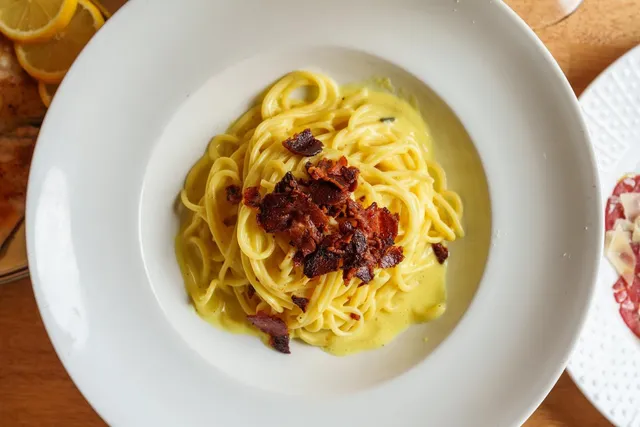
 Cacio e Pepe has three ingredients. That is why ordering it in San Diego tells you exactly who knows what they are doing — in a dish this simple, there is nowhere to hide. Romanissimo Cucina Italiana at 644 Fifth Ave in the Gaslamp Quarter serves cacio e pepe San Diego food lovers can hold against the Roman original: tonnarelli pasta, Pecorino Romano, and black pepper. No cream. No substitutions. No shortcuts.
Three Ingredients. Zero Margin.
Cacio e Pepe means “cheese and pepper” in Roman dialect. The name is the recipe. Tonnarelli pasta — a thick, squared-off pasta from Rome — gets coated in a sauce made from Pecorino Romano dissolved into starchy pasta cooking water, finished with coarsely cracked black pepper. That is the entire dish.
The simplicity is where the difficulty lives. An emulsion built from pasta water and aged sheep’s milk cheese — with no butter, no cream, no egg — is one of the more technically demanding preparations in Italian cooking. The difference between a glossy, strand-coating sauce and a broken, clumped mess is a matter of temperature, timing, and technique. Most restaurants add cream because cream removes that difficulty. That’s also why most cacio e pepe in San Diego tastes like an approximation of the Roman original rather than the thing itself.
Why Tonnarelli Is the Right Pasta
Roman cooks use tonnarelli for Cacio e Pepe. Not spaghetti, not linguine, not rigatoni. Tonnarelli is made with egg dough and cut into a thick square cross-section — the same dimensions in width and height. That texture gives the sauce something to grip. The slightly rough surface holds the emulsion in a way that smoother, thinner pasta simply does not.
The pasta’s density matters for another reason: the emulsification process happens off direct heat, with the pasta being tossed vigorously as the cheese and water come together. A delicate pasta would overcook during that step. Tonnarelli holds its bite. The authentic cacio e pepe recipe depends on that structural quality — the pasta is not interchangeable with whatever is on hand.
Pecorino Romano: The Cheese That Builds the Sauce
The cheese in Cacio e Pepe is Pecorino Romano. Not Parmigiano-Reggiano. This is not a matter of preference — it is a matter of the sauce working correctly.
Pecorino Romano is made from sheep’s milk and aged until it develops a sharpness and salt level that Parmigiano’s milder, nuttier flavor cannot replicate. When dissolved into hot pasta water, Pecorino creates a sauce with a specific tang and salinity that is the defining flavor of the dish. Parmigiano makes something that tastes pleasant and broadly Italian. Pecorino makes Cacio e Pepe. The two cheeses are not doing the same job.
Some Roman cooks blend a small percentage of Parmigiano into the Pecorino to round out the sharpness. That is a defensible choice. But any authentic cacio e pepe recipe has Pecorino as the foundation. A recipe that leads with Parmigiano — or treats them as equivalent — is not making the Roman dish.
Want to try the real thing before reading further? Reserve a table at Romanissimo — the best cacio e pepe downtown San Diego has to offer is waiting.
Black Pepper: Not a Garnish, Half the Dish
The pepper in Cacio e Pepe earns its place in the name. Coarsely cracked black pepper is toasted in a dry pan before the pasta water is ever set to boil. That toasting blooms the volatile aromatic oils in the peppercorns and softens the heat from sharp to round. What you get after toasting is pepper that smells and tastes like more than just heat.
The correct pepper for this dish is freshly cracked from whole peppercorns — not pre-ground, not white pepper, not the contents of a shaker that has been sitting on the line. Pre-ground pepper has lost most of its aromatics by the time it hits a hot pan. A dish called “cheese and pepper” where the pepper is inert is not the dish. At Romanissimo, the black pepper is cracked fresh, toasted properly, and treated as a primary ingredient — not finishing seasoning.
The Emulsion: What Most Kitchens Skip
The technique that separates authentic Cacio e Pepe from any cream-based version is the emulsion. Pasta cooking water — water that has been boiling with pasta in it for several minutes — contains enough dissolved starch to act as an emulsifier when combined with finely grated Pecorino Romano off direct heat. That starch is what allows the cheese to form a sauce instead of a clump.
The process requires pasta water at the right temperature, added in the right amounts, while the pasta is being tossed quickly. Too hot and the cheese seizes. Too little water and the sauce breaks. Too much and it becomes a thin, greasy slick. A skilled cook is working within a narrow range every single time. There is no safety net.
Restaurants that add cream are not making a richer version of the dish. They are making a different dish that sidesteps the technical challenge. It is easier to execute. It also has nothing to do with Roman cucina romana tradition.
What Bad Cacio e Pepe Looks Like
Order Cacio e Pepe at a restaurant using cream and you get pasta in white sauce. Creamy, mild, inoffensive — possibly good on its own terms, but not what the dish is supposed to be. The sharpness is gone. The emulsion that defines the texture is gone. What’s left is pasta with a cream sauce that someone has named something else.
Order it at a place using Parmigiano instead of Pecorino and the sauce tastes flatter, less defined. The edge that makes the dish memorable has been removed. Order it where the pepper is pre-ground and the “pepper” in “cheese and pepper” becomes decorative rather than structural.
A properly made Cacio e Pepe looks matte, not creamy. The sauce clings to each strand of tonnarelli without pooling at the bottom of the bowl. The pepper is visible in coarse cracks throughout. The flavor is sharp, salty, and direct. There is nothing that needs balancing or softening. It does not want anything added to it.
Frequently Asked Questions About Cacio e Pepe
Does Cacio e Pepe have cream in it?
Authentic Cacio e Pepe has no cream. The sauce is an emulsion of Pecorino Romano and starchy pasta cooking water — no dairy beyond the cheese itself. Cream makes the dish easier to produce and changes its character entirely. Traditional Roman cacio e pepe recipe technique has never included cream, and adding it produces a different dish.
What pasta is used in authentic Cacio e Pepe?
Tonnarelli is the traditional pasta for Roman Cacio e Pepe. It is a thick, egg-based pasta with a square cross-section that grips the sauce better than round spaghetti. Some Roman cooks use rigatoni for a different textural result, but tonnarelli pasta is the standard and the one Romanissimo uses.
What cheese belongs in Cacio e Pepe?
Pecorino Romano — a hard, aged sheep’s milk cheese from the Lazio region. Not Parmigiano-Reggiano. The sharpness and salt content of Pecorino is what gives authentic Cacio e Pepe its defining flavor. Some versions blend in a small amount of Parmigiano for balance, but Pecorino must be the primary cheese for the dish to taste correct.
Where can I get the best cacio e pepe downtown San Diego?
Romanissimo Cucina Italiana at 644 Fifth Ave in San Diego’s Gaslamp Quarter makes Cacio e Pepe with tonnarelli pasta, Pecorino Romano, and freshly cracked black pepper — no cream, no shortcuts. It is the only restaurant in San Diego built specifically around Roman cuisine, and the closest thing to a Roman original the city currently has.
The Best Cacio e Pepe San Diego Has Right Now
Cacio e Pepe is a dish that rewards going to the right place. The gap between a properly made version and a cream-based stand-in is wide enough to notice even if you have never had it in Rome. The technique is either there or it isn’t — and in a three-ingredient dish, it shows immediately.
Romanissimo is the only restaurant in San Diego built specifically around cucina romana — the culinary tradition that produced Cacio e Pepe and the other three Roman pastas. The dinner menu reflects that commitment across every pasta course, not just the one dish.
A 4.7-star rating across 821 reviews and a Top 5 ranking from OpenTable among downtown San Diego Italian restaurants makes the case. Learn more about Romanissimo and what separates a Roman restaurant from everything else in the Gaslamp Quarter.
Ready to Get Started?
Cacio e Pepe done right is waiting at Romanissimo — in the heart of San Diego’s Gaslamp Quarter, where the Roman tradition is the only tradition we follow.
Make a Reservation or call us at 619-235-8144.