

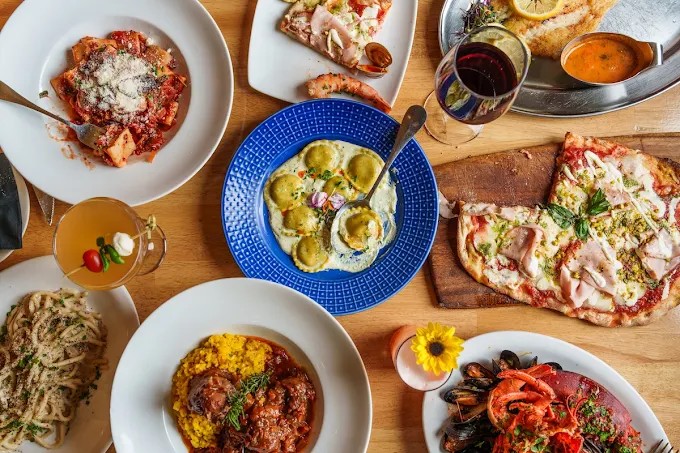
 Roman cuisine San Diego diners can actually experience is a short list — and Romanissimo Cucina Italiana at 644 Fifth Ave in the Gaslamp Quarter sits at the top of it. Most Italian restaurants in San Diego serve dishes pulled from across Italy, blended together under a single “Italian” heading. Romanissimo serves Rome specifically. That’s a distinction that changes the meal from the first bite.
Italy Has Regions. Rome Has Rules.
Italy is not a single culinary tradition. The cooking of Milan shares almost nothing with the cooking of Naples. Tuscany built its identity on bistecca, ribollita, and Chianti. Bologna gave the world ragù alla bolognese and tortellini. These are entirely separate regional traditions that happen to share a border.
Rome’s culinary tradition — cucina romana — operates on different logic. Where northern Italian cooking uses butter and cream, Roman cooking trusts the process. Fat renders slowly from guanciale. Egg yolks create an emulsion without direct heat. Aged sheep’s milk cheese provides the salt, sharpness, and body that a dozen other ingredients would supply elsewhere. The result is food that tastes more direct, because nothing is hidden behind cream or additional stock.
Roman-style pasta has a reputation for intensity. That’s exactly why: fewer ingredients, no shortcuts, and higher stakes on technique. Every element has to carry its full weight.
The Four Pastas That Define Cucina Romana
There are four pastas at the center of cucina romana: Cacio e Pepe, Carbonara, Amatriciana, and Gricia. Every Roman home cook knows all four. Every Roman trattoria serves at least three of them. And not one of them — not a single one — uses cream.
Cacio e Pepe has three ingredients: pasta, Pecorino Romano, and black pepper. The technique is an emulsion made by working finely grated cheese against hot starchy pasta water until it coats every strand. Done wrong, the cheese seizes into a clump at the bottom of the bowl. Done right, it’s one of the most satisfying things Italian cooking has ever produced.
Carbonara uses guanciale, egg yolks, Pecorino Romano, and black pepper. The yolks are tempered by the residual heat of the freshly cooked pasta — not cooked separately in a pan, not extended with cream. The result is rich without being heavy. Amatriciana is a tomato and guanciale sauce that originated in the town of Amatrice, northeast of Rome, and has been a fixture of the Roman table for over two centuries. Gricia is the oldest of the four — Amatriciana without the tomato, sometimes called the “white Amatriciana” — and the one the other three were built on top of.
These are not variations on a single theme. They are four distinct expressions of the same philosophy: restraint, correct ingredients, and technical execution.
If you want to taste what cucina romana actually means, make a reservation at Romanissimo and let the menu do the explaining.
Guanciale: Why Pancetta Is Not a Substitute
Most Italian restaurants in the United States use pancetta in dishes that call for guanciale. Some use bacon. This substitution is common, widely accepted, and wrong — not as a matter of preference, but as a matter of what the dish actually requires.
Guanciale is cured pork cheek. Its fat-to-meat ratio is higher than pancetta, and that fat has a softer, more yielding texture that melts at a lower temperature. When guanciale renders in a pan, it releases fat that is sweeter and more unctuous than anything pancetta produces. The flavor it leaves in the pan — and in the sauce — is the foundation of an authentic Carbonara and a proper Amatriciana. Remove it and you have a similar-looking dish that tastes like something else.
Pancetta is a fine ingredient. Bacon is excellent in the right context. Neither is guanciale, and neither produces the same result. At Romanissimo, guanciale is the standard — not because it’s harder to source, but because the dish requires it.
Pecorino Romano vs. Parmigiano: They Are Not Interchangeable
Parmigiano-Reggiano is one of Italy’s great cheeses. It is also not the right cheese for traditional Roman pasta. That role belongs to Pecorino Romano — a hard, aged sheep’s milk cheese with a sharpness and salt level that Parmigiano simply cannot match.
The traditional Roman dishes are structured around Pecorino Romano’s flavor profile. Cacio e Pepe without it is a different dish. Carbonara with only Parmigiano tastes flatter, less defined, missing the edge that makes the dish memorable. The cheese is not a garnish here — it is part of the sauce’s architecture.
Some Roman recipes blend a small percentage of Parmigiano into the Pecorino for balance. That’s a legitimate choice. But using Parmigiano as the default — which most American Italian restaurants do — shifts the flavor in a direction that has little connection to the Roman original. Knowing that difference is part of what separates traditional Roman dishes from what passes for Italian in most cities.
Beyond Pasta: What the Roman Table Actually Looks Like
Roman cuisine runs well past the four canonical pastas. Coda alla Vaccinara — braised oxtail — is one of Rome’s most storied main courses. It originated in the Testaccio neighborhood, where slaughterhouse workers were paid in the less desirable cuts of the animal. Roman cooks transformed those cuts into dishes that eventually ended up on every serious table in the city.
Supplì — fried rice croquettes with molten mozzarella at the center — are a Roman street food standard that has no real equivalent elsewhere in Italy. Carciofi alla Romana are artichokes stuffed with mint and garlic and braised in olive oil and white wine. Saltimbocca alla Romana is thinly pounded veal with prosciutto and sage, cooked quickly in a pan. Each of these dishes reflects the same principle as the pastas: specific ingredients, direct technique, no ornamentation.
Romanissimo’s dinner menu draws from this full range of Roman cooking. The Polpette di Coda — oxtail meatballs — are built on the same culinary logic as Coda alla Vaccinara: a humble cut, handled with care, turned into something worth talking about. The menu reflects cucina romana as a complete tradition, not just its pasta course.
The Wine of Lazio and Why It Belongs at This Table
Rome sits within the wine region of Lazio. It doesn’t attract the international press that Tuscany or Piedmont receives, but Lazio produces wines that work alongside Roman food in a way that more prestigious bottles often don’t.
The white wines of the Castelli Romani — made primarily from Malvasia and Trebbiano grapes grown in the volcanic hills south of Rome — are dry, light, and built to complement the fat and salt of guanciale-forward dishes. They are food wines. They are not trying to impress on their own. Red wines from Lazio, including those made from Cesanese grapes, are earthy and medium-bodied — the right weight for braised meats and tomato-based sauces.
The wine list at Romanissimo is curated around Italian selections that make the food better. That’s how Roman hospitality works: the wine exists to serve the meal, not the other way around.
Frequently Asked Questions About Roman Cuisine
What makes Roman cuisine different from other Italian food?
Roman cuisine is a specific regional culinary tradition with its own rules, ingredients, and techniques. It uses guanciale instead of pancetta, Pecorino Romano instead of Parmigiano, and egg yolk emulsions instead of cream. Most “Italian” restaurants in the United States serve a blend of dishes from multiple regions. Cucina romana follows its own logic — independently of what Tuscan, Neapolitan, or Milanese cooking does.
Does Carbonara have cream in it?
Authentic Carbonara has no cream. The sauce is created by tempering egg yolks against the residual heat of freshly cooked pasta. Cream makes the dish easier to produce but changes its character entirely. The Roman original has no cream, has never had cream, and doesn’t need it.
What are the four classic Roman pastas?
Cacio e Pepe, Carbonara, Amatriciana, and Gricia. All four use Pecorino Romano and black pepper. Three of the four use guanciale. None of them use cream. These are the defining dishes of cucina romana, and they’re the clearest measure of whether a restaurant is making the authentic version or an approximation.
Where can I try authentic Roman cuisine in San Diego?
Romanissimo Cucina Italiana at 644 Fifth Ave in downtown San Diego’s Gaslamp Quarter is built specifically around Roman cuisine. The menu draws directly from the Roman tradition — correct ingredients, correct technique. It is the only restaurant in San Diego positioned as a specifically Roman restaurant, not a generic Italian one.
Roman Cuisine in San Diego: One Restaurant Gets It Right
Romanissimo earned a 4.7-star rating across 821 reviews and a place in OpenTable’s Top 5 Italian restaurants in downtown San Diego — within its first year of operation. That kind of reception happens when the food is specific and the kitchen knows exactly what it’s making.
The Gaslamp Quarter’s other Italian restaurants are Tuscan, generically Italian, or classic American-Italian. None of them have claimed Roman cuisine San Diego food lovers can hold to a Roman standard. Romanissimo is the only restaurant in the city that has — and it owns that position with a menu and a commitment to the correct ingredients that no other Gaslamp Italian restaurant can match.
Browse the full dinner menu to see what the Roman table looks like when done correctly. Or learn more about Romanissimo — the story, the dishes, and what Roman specificity actually tastes like in San Diego.
Ready to Get Started?
Roman cuisine San Diego diners have been looking for is right here — in the Gaslamp Quarter, at 644 Fifth Ave.
Make a Reservation or call us at 619-235-8144.